
An AI-assisted workflow helps dealers reduce time lost between intake and market-ready for each vehicle.
1 Product Manager
1 Business Analyst
2 Engineers (front-end and back-end)
Overview
Dealerships need to move inventory quickly, but the decision of what to do with each vehicle is complex. A single vehicle can involve condition findings, diagnostic codes, recon cost, market demand, retail upside, margin goals, vehicle history, and timing pressure.
Before this project, those signals existed across different parts of the workflow. Users could inspect a vehicle, review issues, estimate recon work, and compare market data, but they still had to manually connect what those signals meant for the business.
I worked on a product direction that used AI as a decision-support layer across the vehicle lifecycle. The goal was not to create a standalone chatbot or fully automate decisions. The goal was to help users understand context, automate repetitive follow-up steps, and move vehicles forward faster while keeping final decisions in human hands.
My Roles
As the sole product designer, I defined the end-to-end workflow, shaped the role of the AI agent, designed structured agent interactions, and created prototypes to align leadership and engineering around a more connected product direction.
My work included:
- mapping the vehicle lifecycle from intake to market-ready
- identifying where decisions slowed down or context dropped off
- defining what the agent should proactively surface at each step
- designing agent widgets for tasks, estimates, market context, and recommendations
- creating human-in-the-loop approval patterns for business-critical actions
- translating complex dealership logic into clear UI flows and prototypes
Project Impact
Appraisal time reduced from
30–60 minutes to
approximately 10 minutes
Reduced handoff delays between inspection, tasking, and approval
Dealers reported improved confidence in recondition vs. wholesale decisions.
Connected fragmented steps
Brought inspection, diagnostics, market research, recon planning, and disposition decisions into one workflow
Reduced manual interpretation
Lowered the burden of translating raw condition data into operational next steps
Made AI actionable
Used the agent to create tasks, surface relevant research, and support decisions such as auction vs. retail vs. recondition
Extended AI value across the lifecycle
Moved beyond “AI inspection” into a broader workflow that supports continuous vehicle decision making
Final Design - Key Features
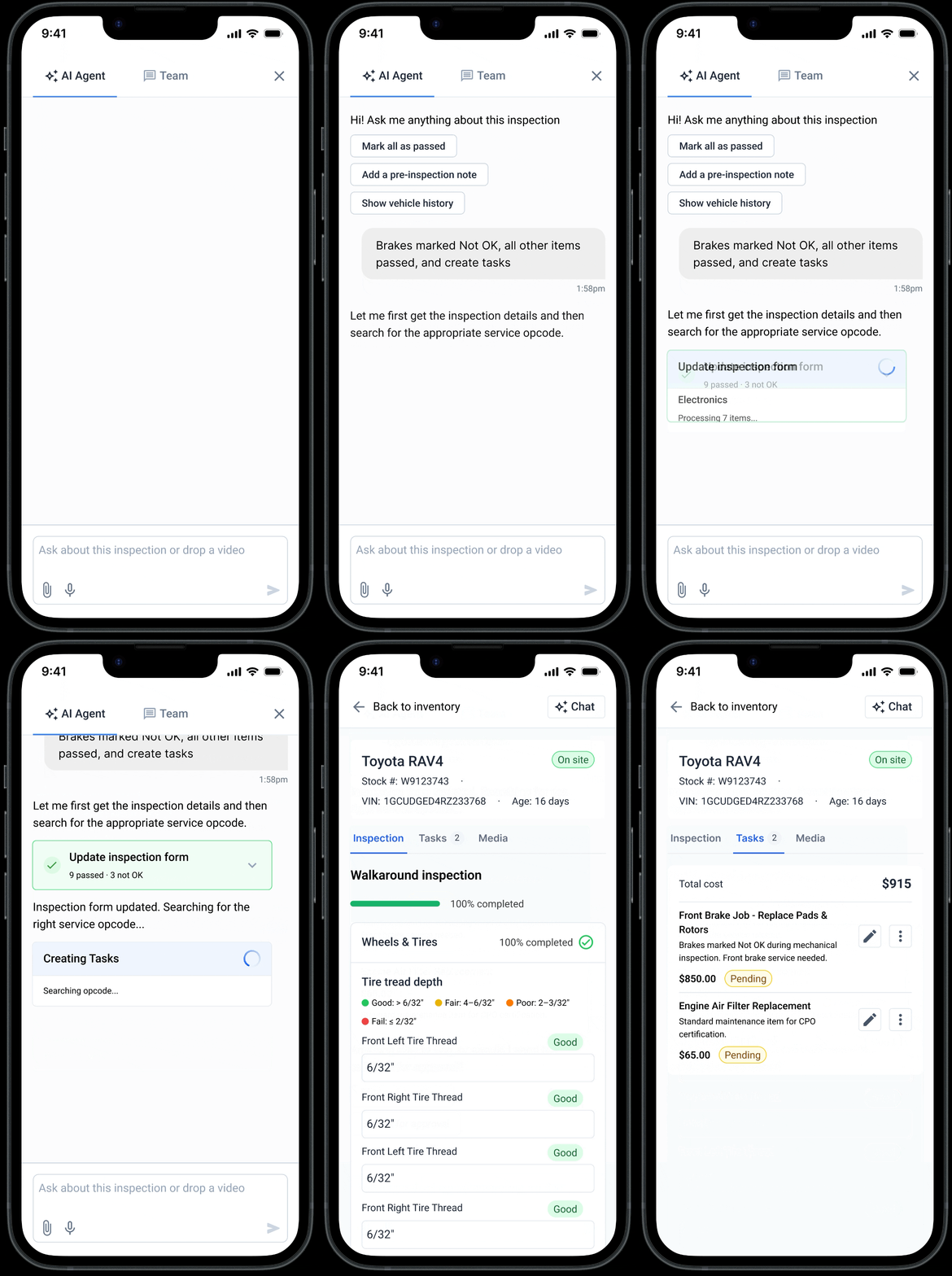
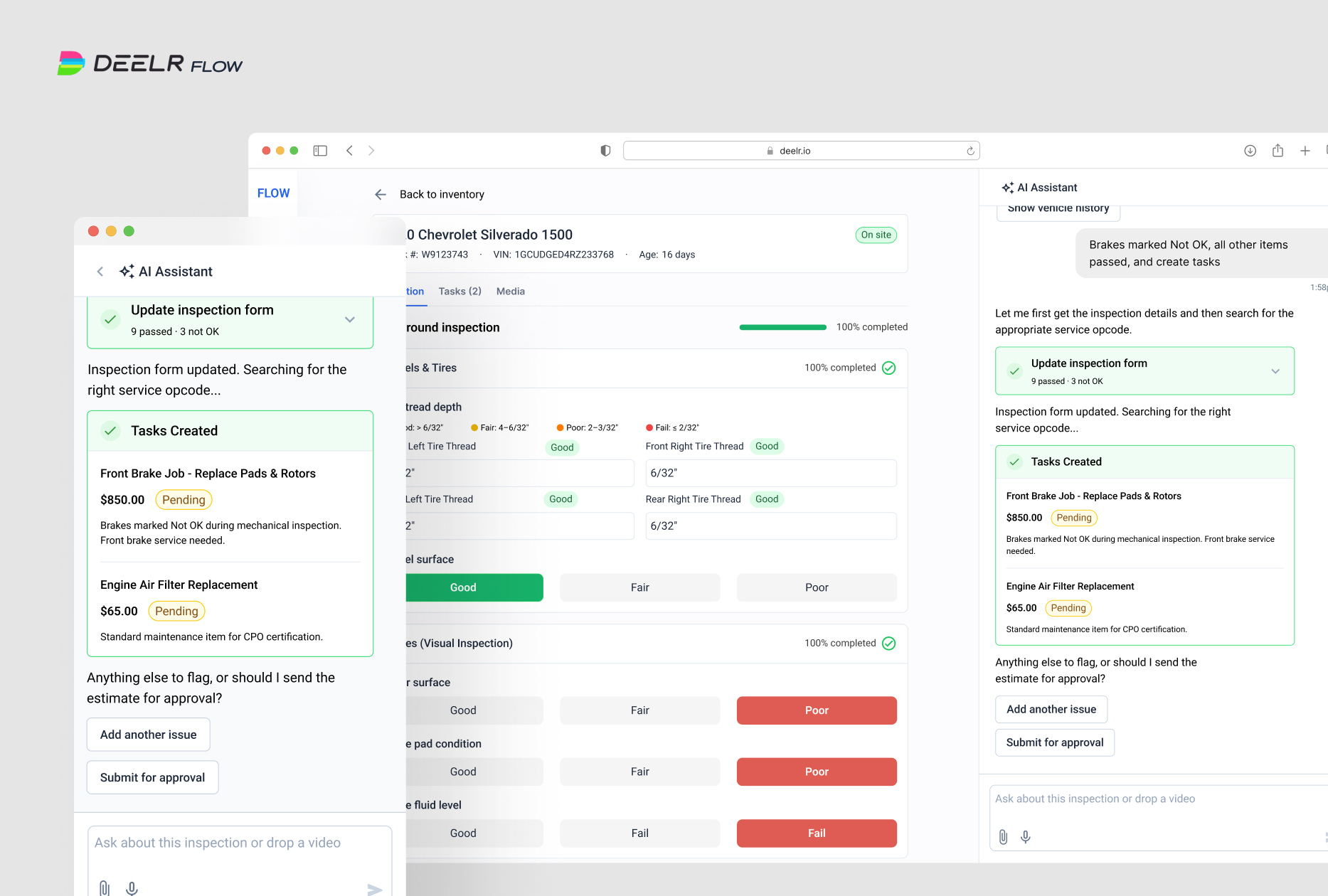
The AI agent turns inspection findings into operational action.
Rather than stopping at issue detection, the agent helps users take the next step. In this flow, a technician flags failed items in plain language, and the system updates the inspection, creates service tasks, and prepares the estimate for approval.
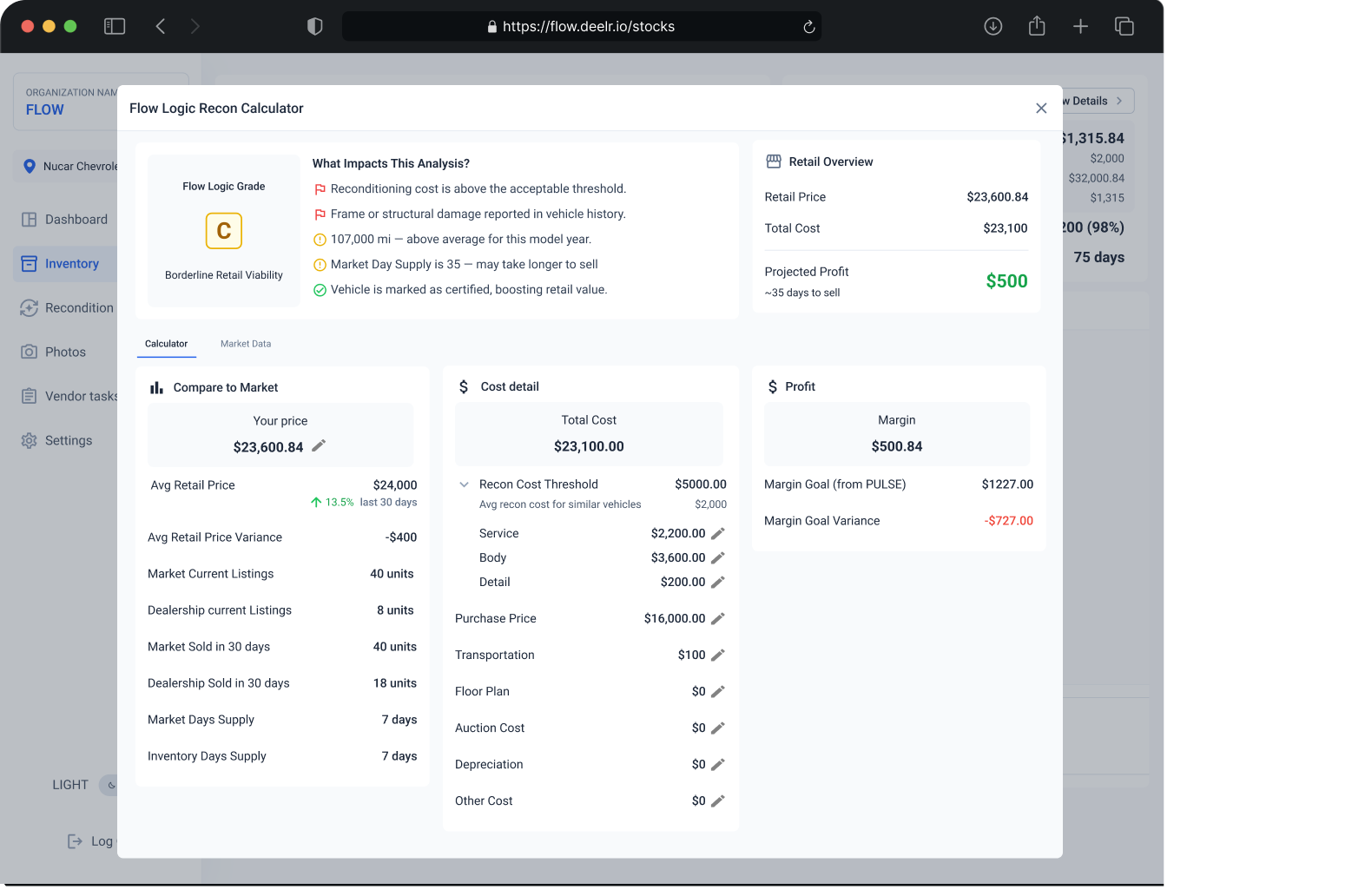
AI-Calculated Grade for Retail vs. Wholesale Decision
AI can function as a decision-support layer for inventory strategy. By combining vehicle history, market conditions, recon thresholds, and projected margin, the system helps users quickly assess whether a vehicle should remain on a retail path or be redirected to wholesale. The value is not only the recommendation itself, but making the reasoning visible enough for users to act with confidence.
Problem Discovery
To understand where decisions slowed down, I reviewed existing dealership workflows, mapped the vehicle lifecycle with product and business stakeholders, and analyzed where users had to manually connect inspection findings, diagnostic issues, recon cost, market data, and disposition decisions.
The strongest pattern was that users were not blocked by one missing data point. They were blocked by having to interpret multiple signals across disconnected steps.
Workflow audit
Mapped where context entered the system, where it was used, and where it dropped off between intake, inspection, recon, and disposition.
Stakeholder alignment
Worked with product, business, and engineering stakeholders to understand which decisions were operationally important, which could be supported by AI, and which needed human approval.
Prototype exploration
Explored early decision-support concepts, including vehicle scoring and grade-based analysis, to test whether faster evaluation alone would solve the problem.
Problem discovery
Early Hypothesis: Faster Evaluation Would Solve the Problem
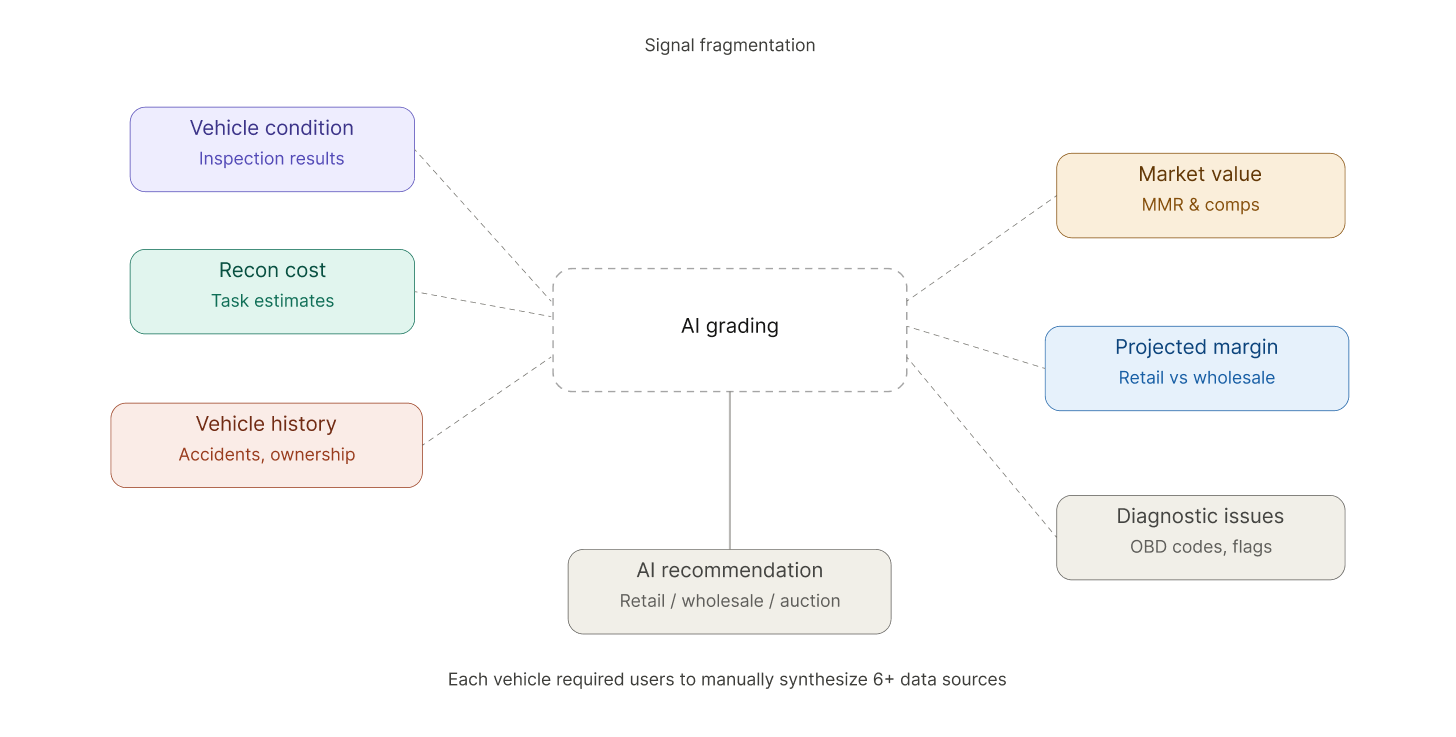
Early in the project, we believed the main problem was that dealerships needed a faster way to evaluate each vehicle.One of our first explorations was a simplified vehicle scoring model. The idea was to assign each vehicle a grade based on signals such as condition, market value, recon cost, vehicle history, and projected margin. A score could help users quickly understand whether a vehicle looked promising, risky, or borderline.
Dealership teams already had access to pieces of the picture: vehicle condition, diagnostic issues, recon tasks, and market information. But these signals were fragmented across steps and often required users to manually interpret what the information meant for the business.
A grade-based decision tool helped summarize vehicle viability, but it still relied on users to interpret the result and initiate the next action.
Dealership teams already had access to pieces of the picture: vehicle condition, diagnostic issues, recon tasks, and market information. But these signals were fragmented across steps and often required users to manually interpret what the information meant for the business.
Early in the project, we believed the main problem was that dealerships needed a faster way to evaluate each vehicle. One of our first explorations was a simplified vehicle scoring model. The idea was to assign each vehicle a grade based on signals such as condition, market value, recon cost, vehicle history, and projected margin. A score could help users quickly understand whether a vehicle looked promising, risky, or borderline.
This direction was useful because it gave the team a simple way to summarize complex vehicle data. But it also revealed a limitation.
The underlying issue was not a lack of data. It was a lack of connected decision support
This created four recurring issues:
1. Important decisions took too long.
Users had to move between different sources of information before deciding whether a vehicle should be reconditioned, retailed, wholesaled, or sent to auction.
2. Next-step actions were inconsistent.
Different users could interpret the same vehicle signals differently, which made outcomes dependent on individual judgment rather than guided system support.
3. Workflow progress depended on manual follow-up.
Even when the product had enough context to suggest the next step, the system often waited for users to come back, review the information, and take action.
4. Context did not carry forward cleanly.
As a vehicle moved from intake to inspection, tasking, recon planning, and disposition, important context could become disconnected from the next decision.This reframed the problem from evaluation speed to workflow momentum.
A dealership does not just need more information about a vehicle. It needs help converting vehicle signals into business action.
This mattered because every delay affects inventory turn. A dealership does not just need more information about a vehicle; it needs help deciding quickly whether that vehicle should be reconditioned, retailed, or moved to auction. The real opportunity was to build a system that helps users convert vehicle signals into business action.
The Core Problem
Dealership teams need to move inventory quickly, but fragmented workflows make it difficult to act fast and profitably.
How might we help dealership teams connect vehicle context, automate repetitive follow-up steps, and make faster decisions without taking control away from the user?
Key workflow gaps
1. Inspection findings rarely translated into an immediate next step
The system could surface condition information, but it did not do enough to help users act on it. Teams still had to decide manually whether to create tasks, investigate further, or change the vehicle’s path.
2. Recon decisions were not tightly connected to market upside
Knowing what a vehicle needed was only part of the problem. Users also needed to understand whether the work was worth doing based on value, demand, and retail potential.
3. Users were forced to connect technical details with business decisions on their own
Diagnostic issues, condition findings, and cost considerations all affected the outcome, but the workflow did little to help users synthesize those signals into a clear recommendation.
4. Context broke down across the vehicle lifecycle
As a vehicle moved from intake to inspection, tasking, and disposition, decision context did not carry forward cleanly. That fragmentation slowed the workflow and made outcomes more dependent on individual judgment than system support.
Opportunity
We saw an opportunity to reposition AI from a feature into a lifecycle decision layer.
Instead of using AI only to detect issues, summarize findings, or answer open-ended questions, the product could use an AI agent to help users move through the vehicle lifecycle with more context and less manual coordination.
The agent could help users:
interpret what vehicle signals mean for the business
create the right follow-up tasks
pull the most relevant market and vehicle history context
identify whether additional recon investment makes sense
prepare recommendations for retail, recondition, wholesale, or auction
move the vehicle to the most appropriate next path faster
The design goal was not full automation. It was faster, more informed human decision-making.
Agent Workflow Strategy
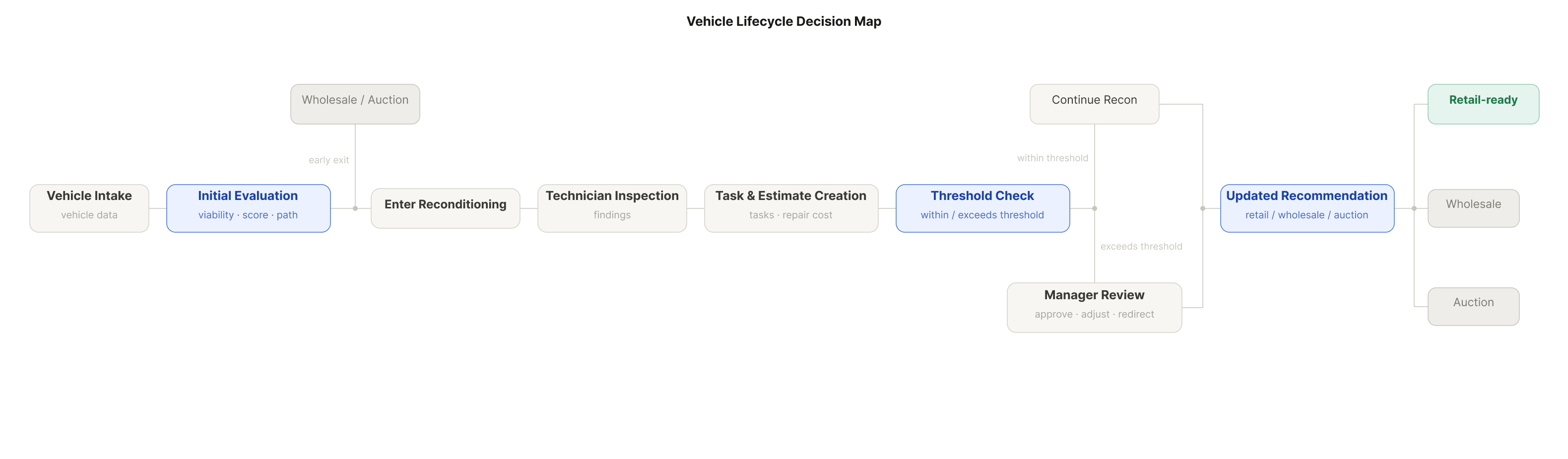
To define where the agent could add value, I mapped the vehicle lifecycle around user goals and decision points.
Instead of using AI only to detect issues, summarize findings, or answer open-ended questions, the product could use an AI agent to help users move through the vehicle lifecycle with more context and less manual coordination.
The agent could help users:
1. Initial viability decision
The agent summarizes vehicle history, market value, recon threshold, and projected margin to help users decide whether the vehicle should go wholesale or continue toward retail.
2. Reconditioning entry
If the user decides to invest in reconditioning, the agent carries forward the original assumption: expected recon cost, threshold, margin goal, and retail path.
3. Technician inspection
The agent supports technicians by helping interpret inspection inputs, identify relevant service tasks, and access parts and labor pricing.
4. Task and estimate creation
Inspection findings become structured recon tasks with estimated cost, status, and approval actions.
5. Threshold monitoring
The agent compares updated repair estimates against the original recon threshold and margin goal.
6. Manager approval
If new costs exceed the original assumption, the agent prepares context and notifies the manager to approve, adjust, or redirect the vehicle.
7. Updated disposition recommendation
As cost, condition, or market signals change, the agent updates the recommendation for retail, recondition, wholesale, or auction
Interaction Model Exploration
Interaction Model: Global Chat Agent vs. Contextual Agent
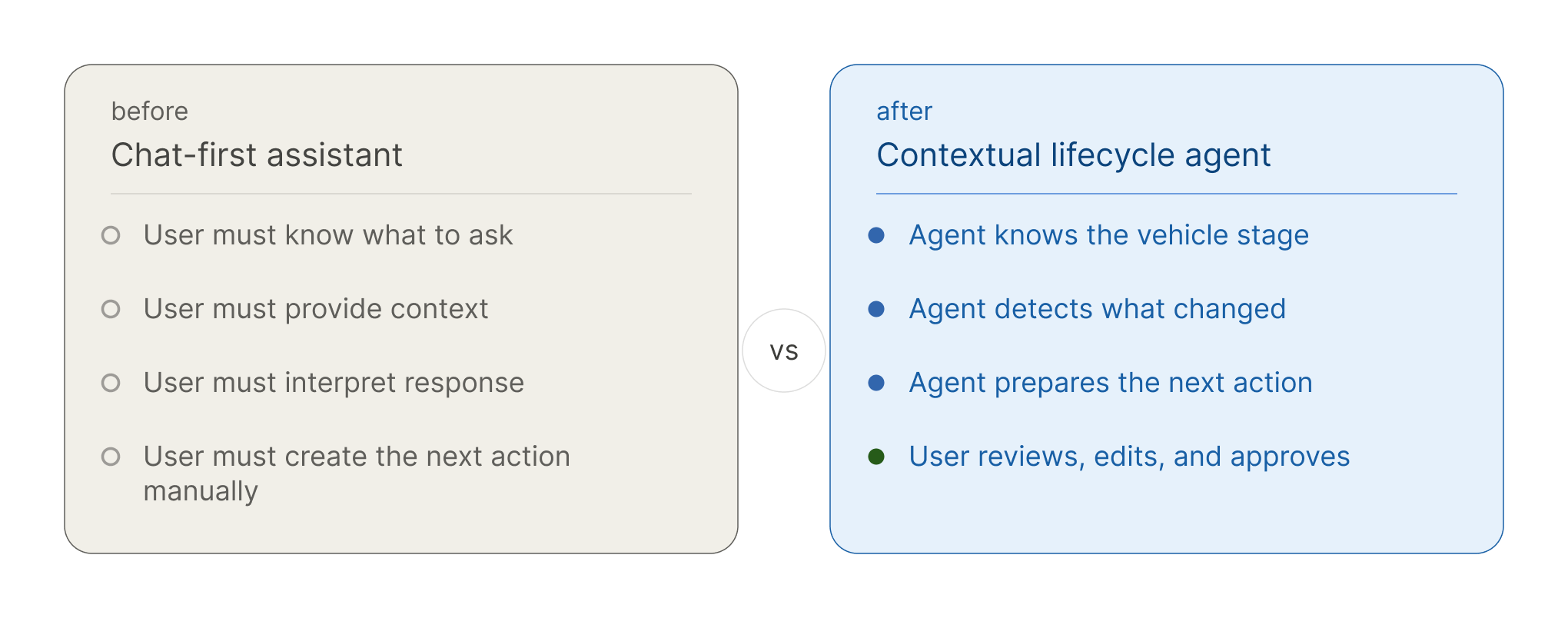
One of the key design challenges was deciding how users should interact with the agent.
An open-ended assistant was flexible, but it placed too much burden on the user. A manager would need to know what to ask about margin risk. A technician would need to ask for the right service opcode or parts and labor estimate. A user would still need to translate the response into a task, approval request, or recommendation.
For this workflow, the agent needed to be more contextual. Instead of starting with a blank chat input, the agent should understand where the vehicle is in the lifecycle and proactively surface the next useful action.