
1 Product Manager
2 Engineers
Empowering restaurant servers with actionable guest insights for a B2B loyalty app
Overview
Blackbird is a Web3 loyalty platform that helps restaurants recognize and reward loyal Blackbird guests. As the company expanded, it faced a challenge. Servers, the people actually delivering the rewards, lacked visibility into guest insights, leading to missed rewards and guest complaints.
My Roles
I led the revamp of the Sidecar experience to introduce a tagging system that made guest insights accessible, scannable, and actionable for restaurant servers.UX/UI Design: Leading the design from concept through to high-fidelity prototypes, focusing on usability and responsiveness.
The problem
How might we help restaurant servers instantly recognize guests and act on key insights at a glance to ensure a satisfying dining experience without disrupting their workflow?
With restaurants struggling to utilize Blackbird B2B products to serve guests effectively, the Blackbird team saw a significant drop in user retention and received numerous complaints about missing exclusive rewards at partner restaurants. I was tasked with fixing this issue ASAP.
Goal
Ensure that every Blackbird guest receives the rewards and delightful service they deserve during each visit.
Reduction in guest complaints
Reduce complaints from guests indicate improved reward delivery and smoother server execution.
Restaurant Partner Retention / Satisfaction
Make Blackbird ToB products an essential, enjoyable, and frequently used tool by restaurant staff
Tool Adoption Rate
The % of servers actively using the Sidecar app during service hours
Initial discovery
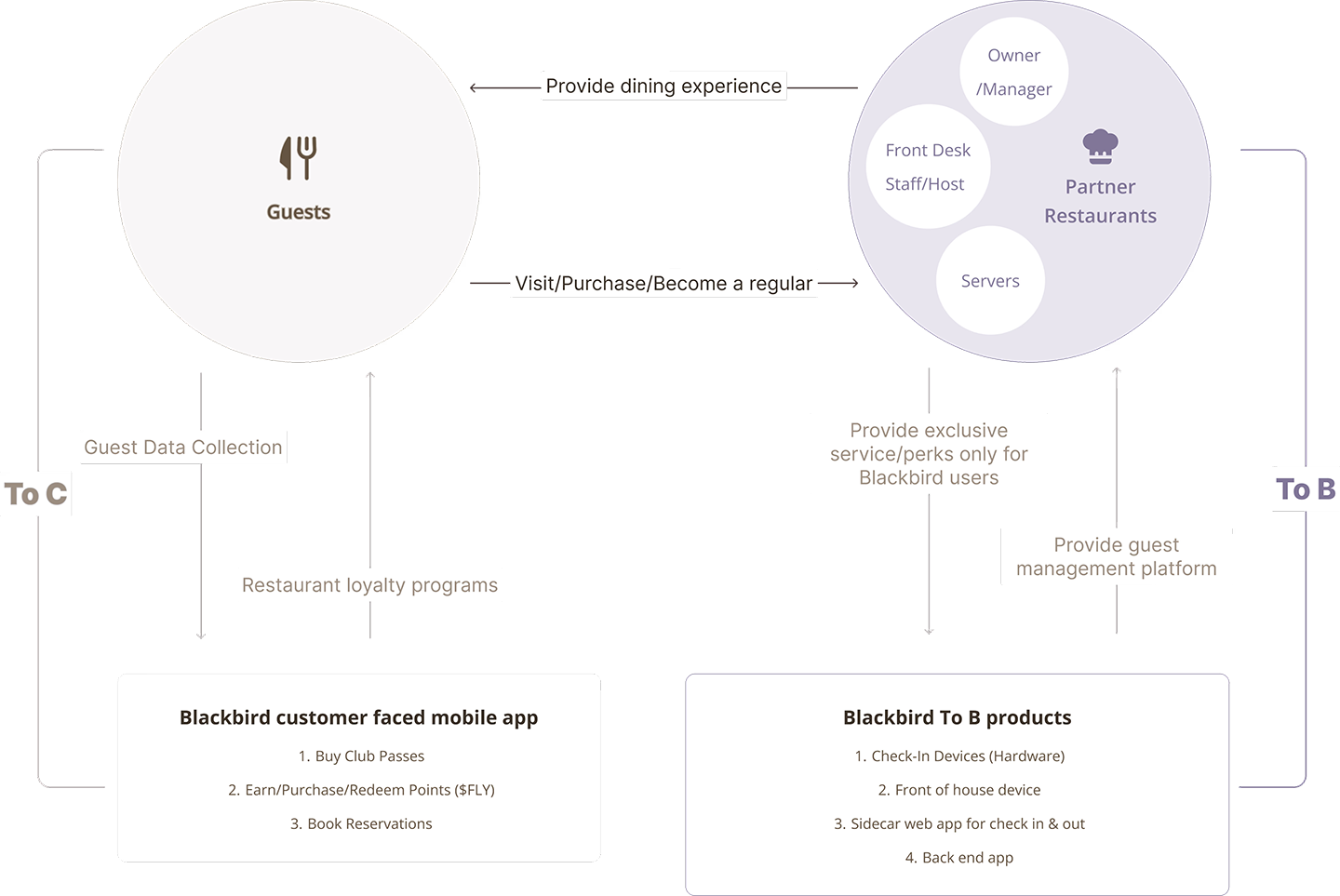
The ideal Blackbird dinning experience
However, after mapping the reward flow from guest check-in to server interaction and combining feedback and service flow research, it became clear that reward data was only accessible to managers in the FOH system. Servers, who only use sidecar devices, were forced to rely on second-hand information from either managers or guests, leading to frustration for both staff and Blackbird guests.

User interview
“I wish I know guest insights the moment they walk in. It would make serving them so much smoother.”
--Eva, Restaurant server
Key insights
1. Servers, not managers, are responsible for delivering rewards, but they lacked access to relevant guest information.
"Managers might see the data, but I’m the one talking to the guest. I’m kind of guessing most of the time." "I’m the one who hands out the rewards, but I don’t actually know who this guest is."
2. Servers are extremely busy and have limited time to engage with digital tools.
"If I have to click more than once, I’m not going to use it during a rush.” “Anything that slows me down by even 10 seconds just won’t happen.” “I need it to tell me what I need to know in one glance.”
3. Guest Value Score (GVS) was difficult to interpret.
“Is a 72 good? Is that high? Should I give them something?” “I don’t know how to act on that number.” “It feels like data for corporate, not for me.”
Designing phase
Iteration 1 – Information Density Problem
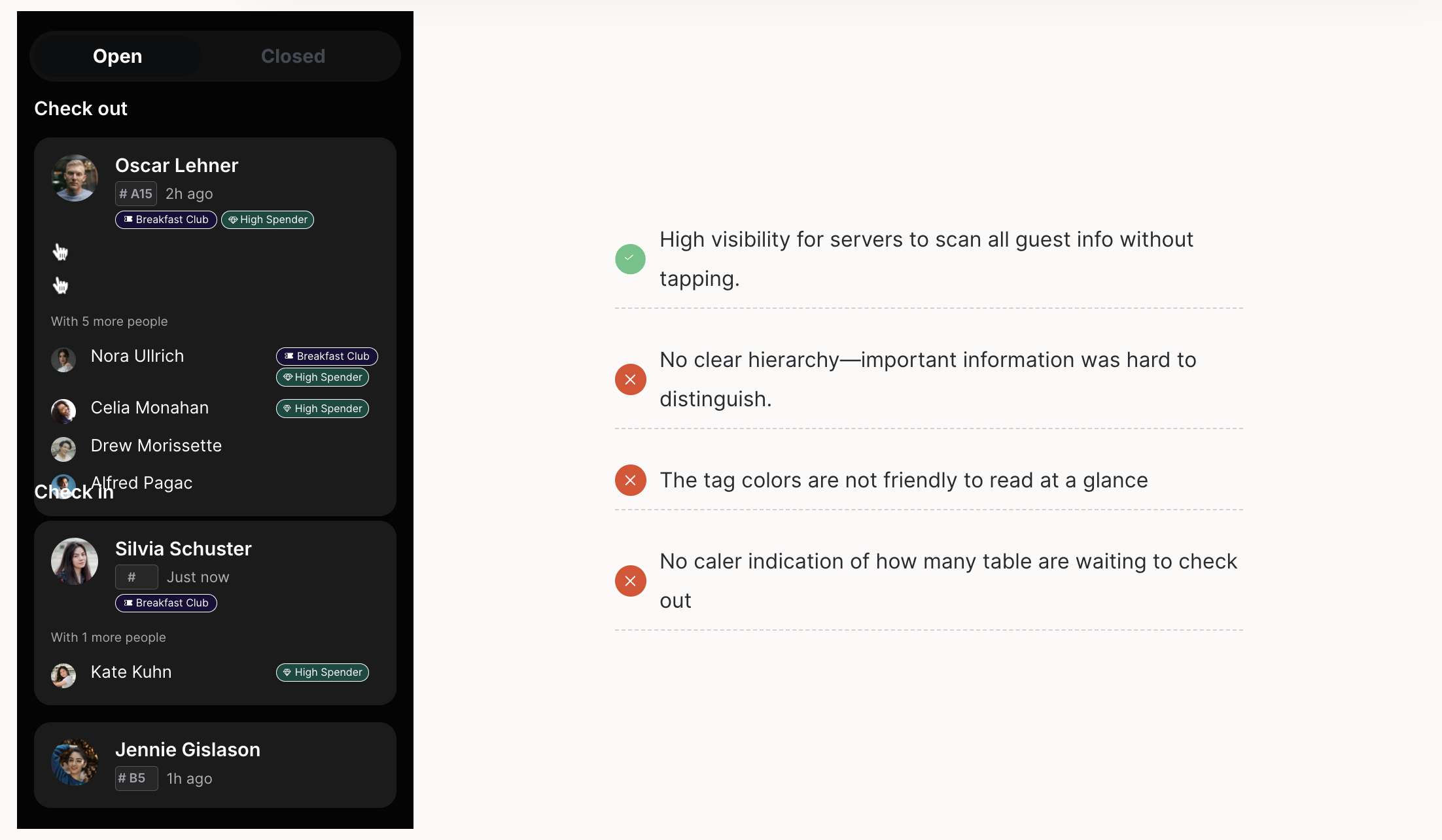
After exploring the product ecosystem, I realized groups often check in under one name for billing. This allowed us to shift reward visibility from individuals to table-level, reducing server effort. My first design exploration focused on how to surface all guest reward insights in a single, scannable table card, helping servers quickly act without cognitive overload.We send this version with two partner restaurants as “causula” testing due to time constraints. The response was positive: staff found the guest tags intuitive and much clearer than abstract scores. They could immediately identify guest value levels and appreciated having insights readily visible in Sidecar. However, they also noted that displaying all guest data could overwhelm, especially for large parties.
Iteration 2 – Structured Hierarchy
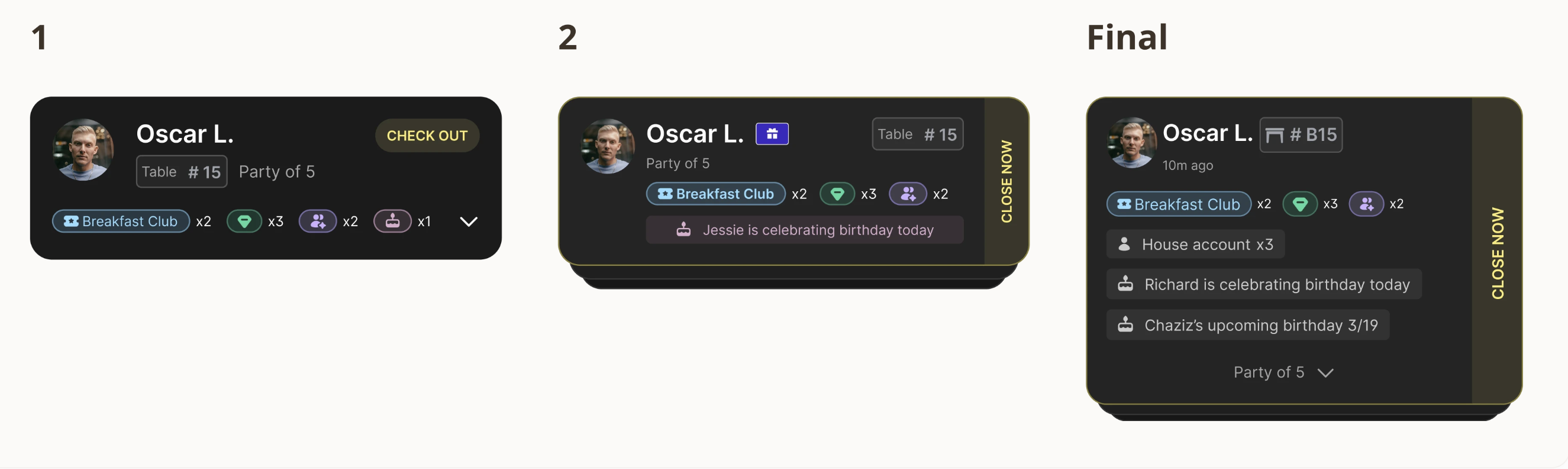
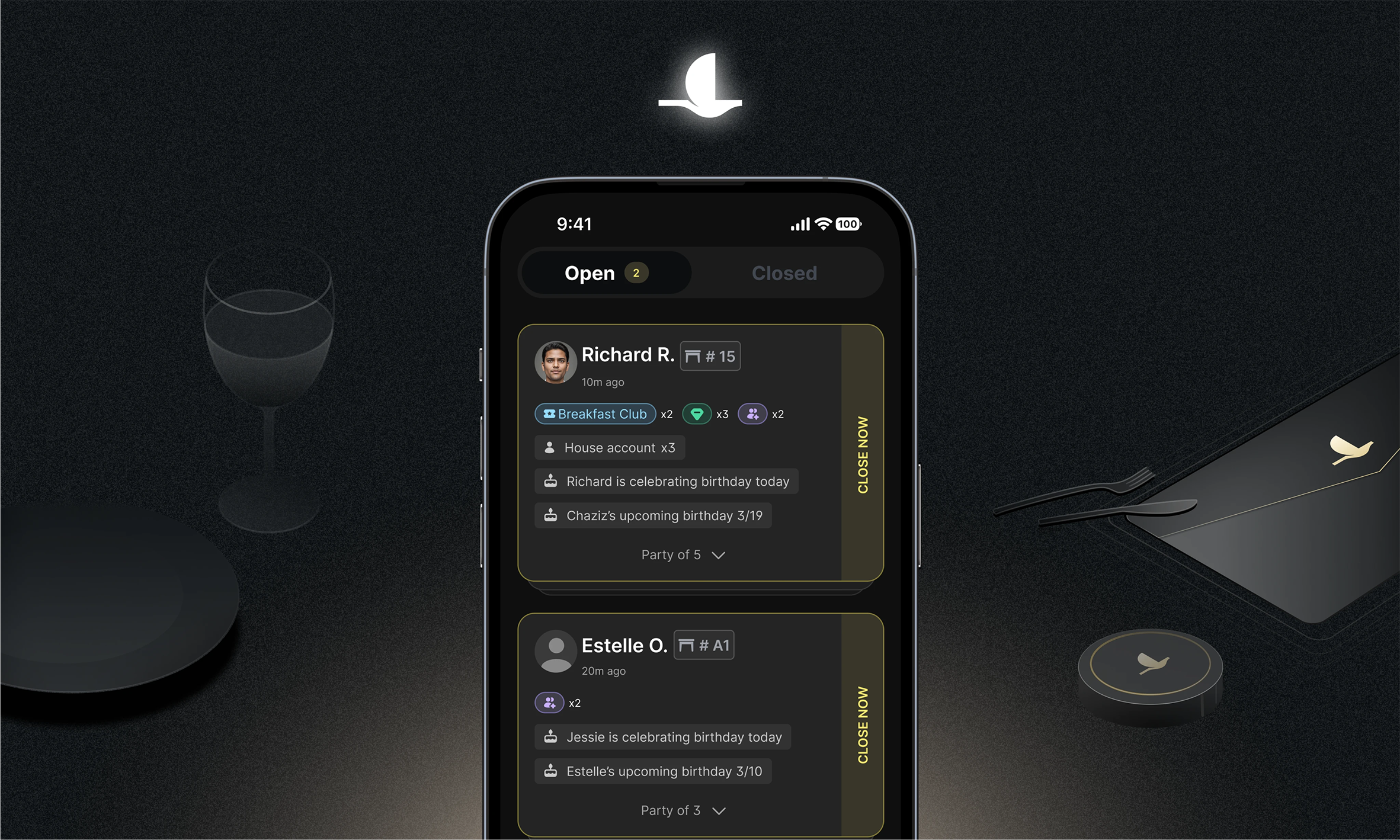
We introduced:A clearer visual hierarchy (Name → Table → Party)
- Condensed tag system
- Status-based vertical action (“Close Now”)
- Highlight for contextual events (e.g., birthday)
This reduced scanning effort and made the primary signals clearer.
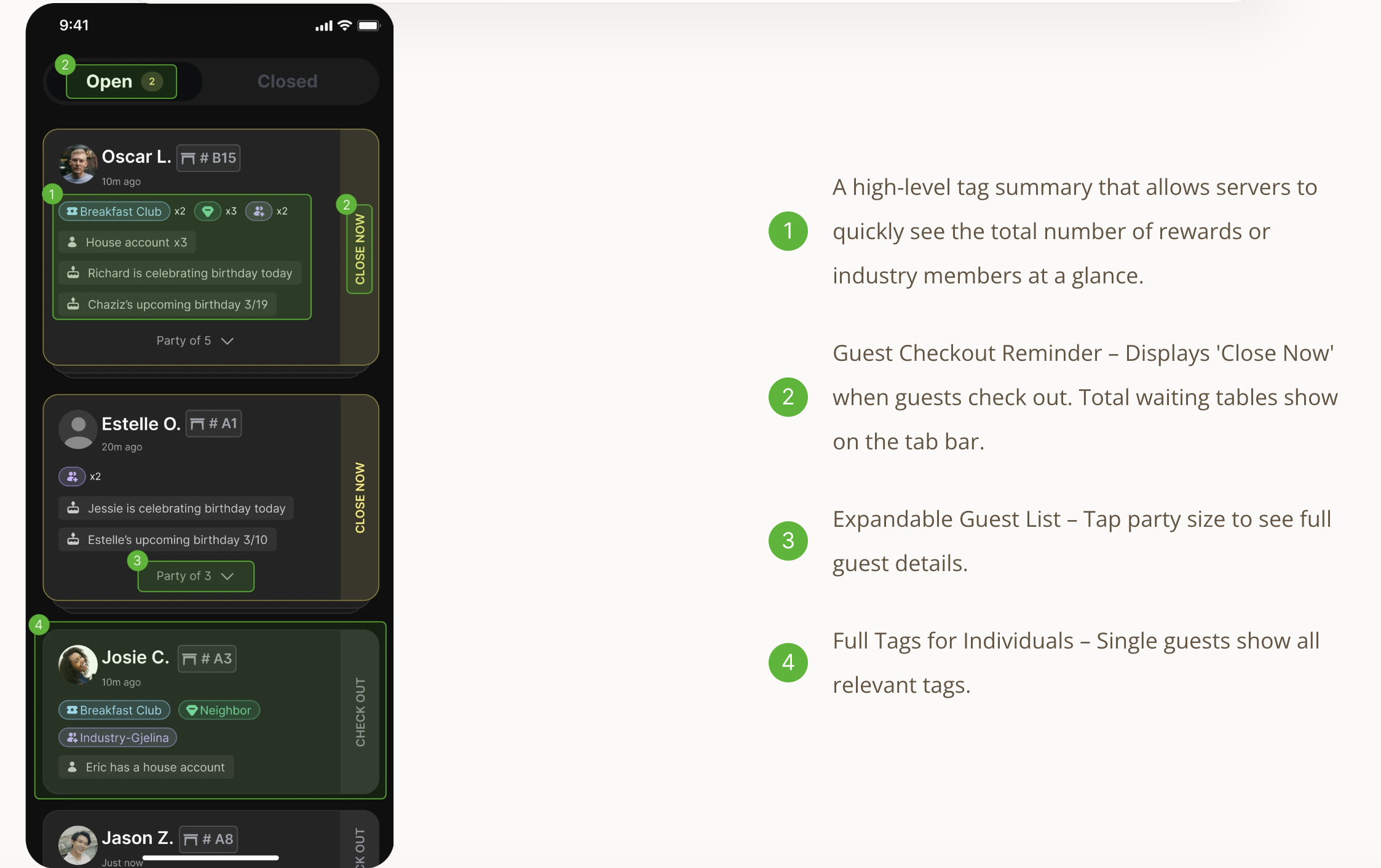
By introducing hierarchical structure, expandable party views, and behavior-driven tags, the design reduced cognitive load and enabled real-time personalization during service.
During research, we observed that reward delivery and loyalty recognition often failed at the final moment — checkout.Servers were responsible for honoring rewards and acknowledging special statuses, but:They didn’t always remember which rewards applied.They had no structured confirmation step.Loyalty moments were easily missed during rush periods.The opportunity was to embed a lightweight review checkpoint before sending the bill to POS.
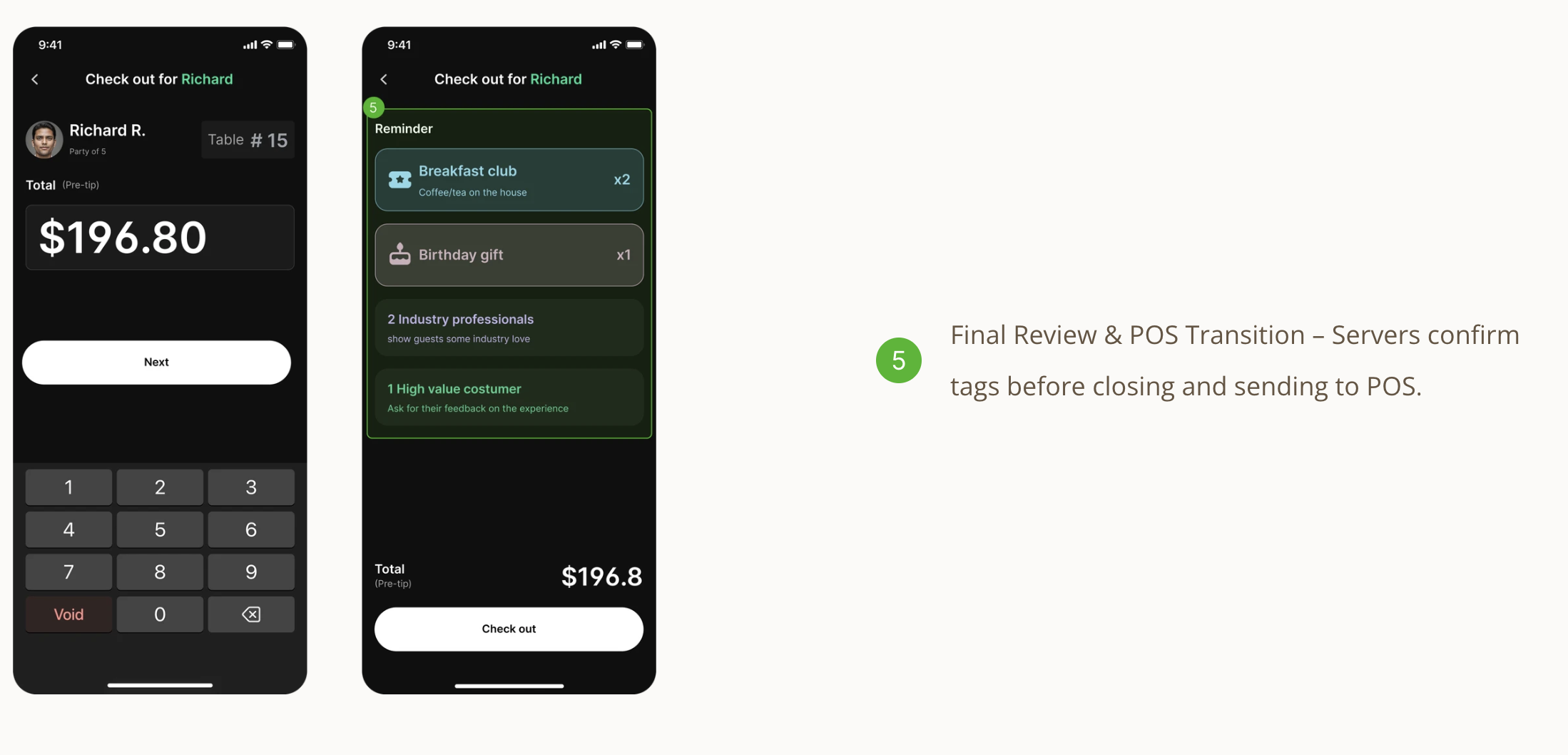
Solution: Integrated Reward Review Step
Before closing the tab, servers are presented with a clear, structured summary of:Applicable rewards (e.g., Breakfast Club x2)Celebration cues (Birthday gift x1)Industry affiliationsHigh-value guest indicatorsEach tag is paired with a behavioral prompt (e.g., “Show guests some industry love”).This reframes loyalty data into:Actionable service cues.
Reflection
1. Data Is Not the Same as Decision Support
The original system relied on abstract metrics like Guest Value Score. While analytically sound, it placed interpretation on the server.In redesigning the card, I focused on translating metrics into behavioral cues. Instead of showing a score, we showed “High value customer". Instead of raw loyalty tiers, we surfaced interpretable tags like “Breakfast Club x2.”
The insight was simple but powerful: Design should reduce decision-making effort, not increase it.
2. Timing Matters More Than Volume as Decision Support
The most meaningful design shift was embedding the loyalty review directly into the checkout flow.Rather than creating a separate dashboard or relying on proactive exploration, we surfaced just-in-time reminders at the exact moment servers were about to close the tab.That small shift in timing turned passive data into an operational safeguard.It reinforced that experience design isn’t just about what is shown — it’s about when it is shown.
3. Designing for Rush Conditions Changes Everything
Restaurant environments are uniquely demanding. During peak hours, servers operate in near-continuous task switching.
This forced me to think differently about hierarchy, glanceability, and progressive disclosure.
Could this be understood in under 2 seconds?
Does this require interpretation?
Is this interrupting flow or supporting it?
Designing under real-world constraints sharpened my focus on cognitive load and behavioral simplicity.